Following up on the price analysis from May 5th and the production analysis from May 7th, our columnist Lucas Botelho has released another hot piece of news today regarding production, price, and the market. Let’s take a look?
To begin with, how is Brazilian production doing?
According to information from the latest Nedspice report on the black pepper market, Brazil is currently among the top three producers, accounting for 14% of the total produced WORLDWIDE !
Black pepper is by far the most produced and traded pepper in Brazil. Today, the states of Pará and Espírito Santo lead the country’s production ranking; however, Bahia has been increasing its share of national production due to the intensification of black pepper cultivation in the south of the state.
Bahia currently accounts for 5% of national production, while the states of Espírito Santo and Pará account for 40% and 54% of the total, respectively.
Is the expectation for an increase or a decrease in production?
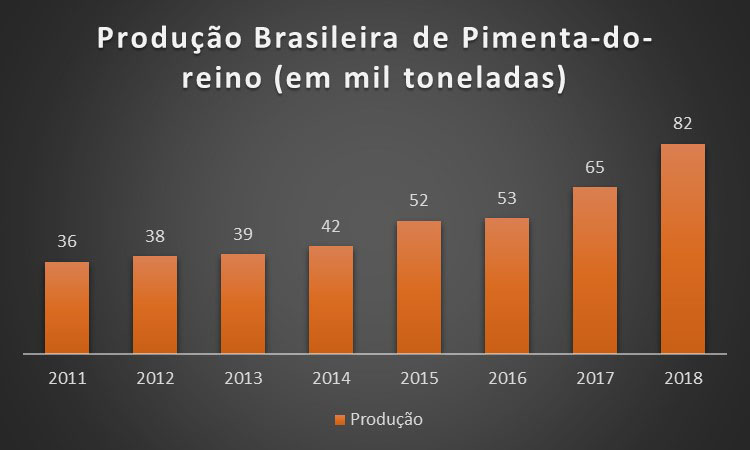
Production remains strong in Brazil, and growth is expected to reach approximately 26% in 2018, reaching 82,000 tons of black pepper.
This increase will be reflected in the level of Brazilian pepper stocks, which are expected to jump from 41,000 to 70,000 tons, a growth of about 71%!
The graph below shows how Brazilian production has been growing rapidly in recent years. A source of pride for farmers!
But what about the price? What’s the trend in the international market?
Prices in international trade continue to fall (remember that so far we are only talking about pepper traded in dollars). However, on a positive note, we are getting closer to the end of the downward cycle. In the short term, Nedspice indicates that prices tend to be more stable, however, in the medium and long term the downward trend continues.
But what is the impact of the rising dollar?
In recent weeks we have witnessed a sharp rise in the exchange rate of the US dollar, which reached almost R$4.00. This increase is largely explained by changes in the US economy. With the economy booming and unemployment at low levels, there is an expectation of increased inflation, which leads the government to raise the basic interest rate to balance this pressure on prices.
Want to receive this and all other news on your cell phone? Sign up using the button below:
The best news in the palm of your hand.
How does this affect Brazilian farmers?
This exchange rate fluctuation can be positive or negative for the Brazilian producer. It all depends on their costs and marketing strategy.
One downside to this situation could be the cost of purchasing supplies. If the dollar is high when buying pesticides, fertilizers, or agricultural machinery (which are mostly imported), the producer may experience a considerable increase in production costs.
On the other hand, if the producer exports their production, they can benefit from the dollar revenue and increase their gross income during that period.
The problem lies in how much the dollar can fluctuate between the times of purchasing inputs and selling the production.
If inputs are purchased when the dollar is more stable and products (such as black pepper) are sold on the international market when prices are higher, the results will likely be very positive for the producer’s finances. However, if the situation is reversed, there is a high risk of decreased gross income and profit, or even losses, in export operations.
The same thing happens when selling on the domestic market. Since the producer receives payment in reais (Brazilian currency), their costs may increase due to more expensive inputs, while their revenue may remain the same.
The best course of action is to try to minimize risks by always paying attention to market news and also seeking tools that minimize the effects of exchange rate fluctuations, such as contracts.

Lucas Botelho
Bachelor’s degree in Agribusiness – UFV
PepperBlog Writer